
Research
Our research lies at the intersection of cognitive science, machine learning, and computational neuroscience. We ask: "How do biological systems make intelligent decisions?" and "How can we design artificial systems that do the same?"
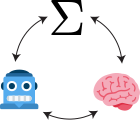
We address these questions through three complementary lines of work centered on formalizing and studying psychological constructs, such as surprise, curiosity, agency, and the sense of control, that are thought to drive intelligent decision-making.
Mathematical formalization
We use mathematical frameworks, from reinforcement learning to information theory, to formalize and organize psychological constructs such as surprise, novelty, and curiosity. For example, we ask: "What exactly does it mean for an agent to be surprised?" and "How can we formally distinguish novelty from surprise?"
- An integrative framework for the human sense of control
- Surprise and novelty in the brain
- A taxonomy of surprise definitions

Experimental studies
We design theory-guided behavioral experiments to determine how these constructs shape learning and decision-making in humans and, through broader collaborations, other animals. For example, we ask: "When exploring an environment, do we seek surprising events or unfamiliar parts of the world?" and "Under what conditions do we feel empowered and in control of our lives?"
- An integrative framework for the human sense of control
- Novelty as a drive of human exploration in complex stochastic environments
- Novelty is not Surprise: human exploratory and adaptive behavior in sequential decision-making

AI applications
We study how these constructs can help us design more efficient AI algorithms and explain the emergent behavior of modern AI systems. For example, we ask: "How can we incorporate different forms of curiosity into AI systems?" and "How can seeking empowerment and control help AI systems acquire complex skills without supervision?"
- Unifying goal-conditioned RL and unsupervised skill learning via control-maximization
- Merits of curiosity: a simulation study
- Learning in volatile environments with the Bayes Factor Surprise

Through these complementary approaches, our work aims to integrate fragmented mathematical and psychological concepts into a more coherent account of intelligent decision-making in humans and machines. Our broader vision is to deepen this understanding and translate it into concrete applications, such as human-aligned AI and new approaches in mental health.
See our publications for the full body of work behind these ideas, and our resources page for the papers, textbooks, and tutorials that shape how we think about this research.